 BLACK FOREST
Enough.
- 00Foreword: A Note From Antonio
- 01The Crisis America Named and Forgot
- 02What Real Protein Is, and How Much
- 03What Replaced It
- 04Take It Back: The Day, and the One Gap
- ·The Receipts & Disclosures
A Note From Antonio
The last two things we sent you were about what was done to you. How the pyramid taught you to fear the one nutrient that holds a body together, and what your grandfather's breakfast had that yours doesn't. This one is different. This one is the manual, the part where you stop being the person things are done to and start being the person who knows exactly what to do.
By the last page you will have three things. Your number, the amount of protein your body actually needs in a day, not the number set to keep you from getting sick. A real day of it, built out of ordinary food, so you can see with your own eyes that it is not a mountain. And the one place that number is almost impossible to hit, the same place for nearly everyone, which turns out to be the whole game.
Here is the honest part, up front. You can do all of this right, eat well at lunch, eat well at dinner, and still lose ground, because there is a hole in the day that food has a hard time filling. That hole has a name now. In 2016 the medical system finally gave it one, and then, in the way these things go, went back to not looking for it.
I sell protein for a living, so read this with the suspicion that deserves. There is nothing to buy in these pages. I would rather you finish knowing your own number and how to hit it than take my word for anything. What you can do without us is exactly what I want you to have. Let me show you what you are up against, and then how simple the answer really is.
To your strength,
Antonio Colmenares
Founder, Black Forest
The Muscle America Named And Forgot
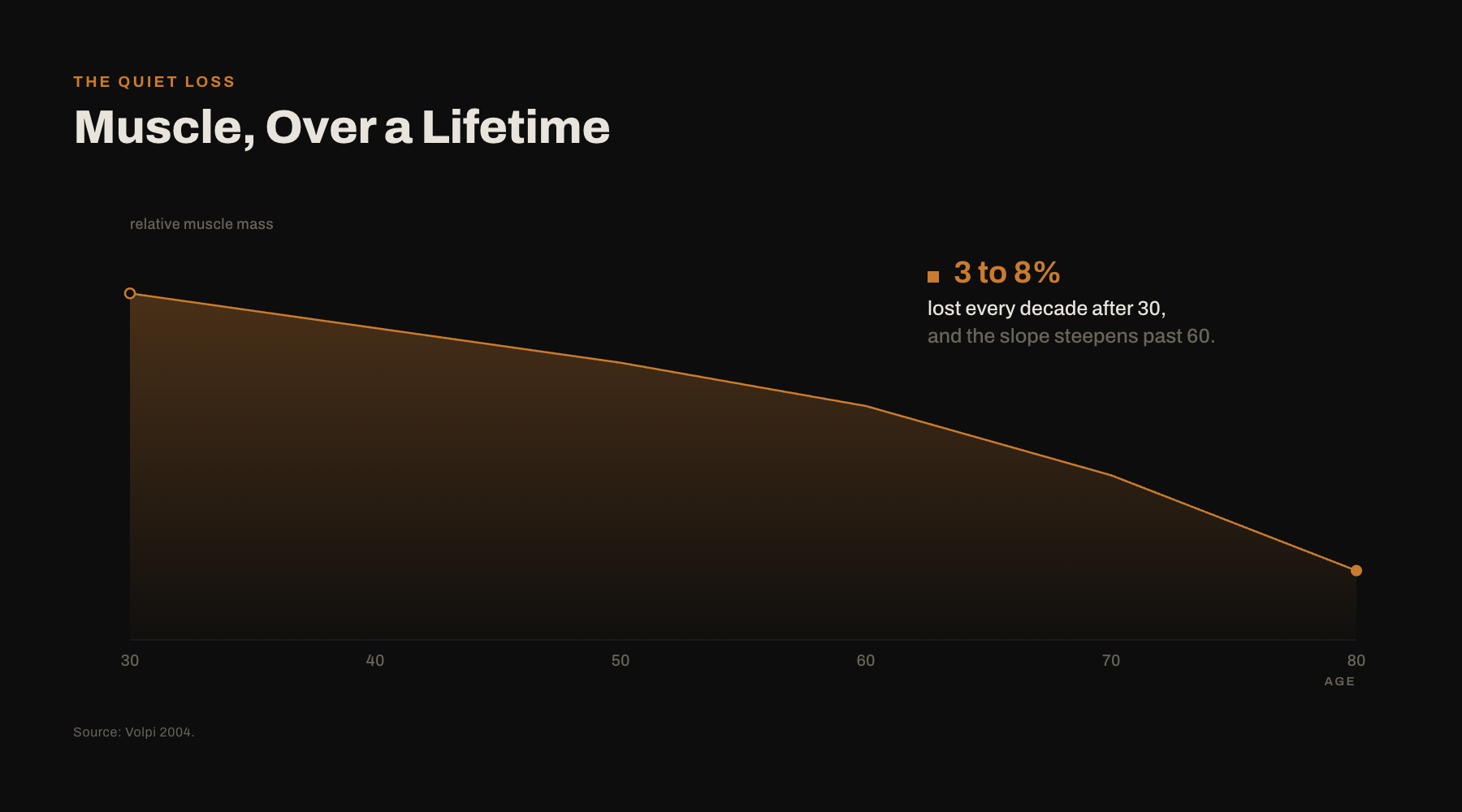
Here is the decline nobody makes an appointment for. Starting around age thirty, the average adult begins losing muscle, three to eight percent of it every decade, and the pace only quickens with time. Not at sixty. At thirty. It is silent, it is gradual, and it is already under way in most people reading this, years or decades before it ever has a name.
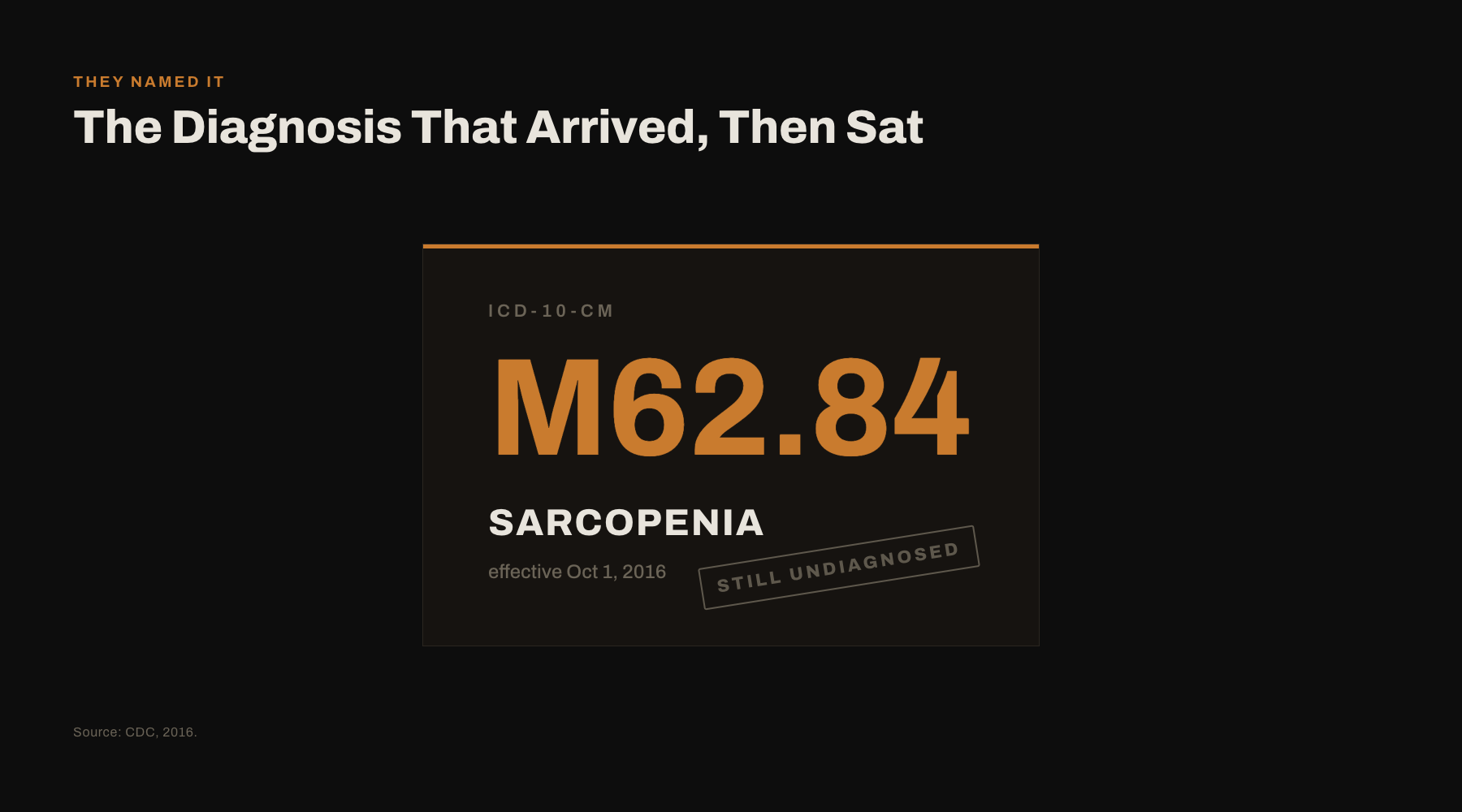
It does have a name for the people furthest down the slope. In 2016, American medicine did something it almost never does. It created a brand new diagnosis code for a condition it had spent decades writing off as simply getting old. The name is sarcopenia, the loss of muscle and strength with age, and with the code, M62.84, it became an official, reportable disease. A disease with a code is one the system agrees is real. And then, in the way these things go, almost nothing happened. Your doctor is unlikely to screen you for it, and you have probably never heard the word.
And it is not a problem you get to leave for later, because later has already started. Measured the same way doctors diagnose it, roughly one in eleven American adults under the age of sixty already meets the criteria for sarcopenia. The slope does not wait for retirement.
This is not a thin, frail problem, and it is not a small one. Nearly three in four American adults, about 72 percent, are now overweight or obese, and only about one in eight is metabolically healthy. Among adults over sixty, more than one in four, 28.3 percent, are in a state called sarcopenic obesity: low muscle and high fat at once. You can be heavier than you have ever been and still be losing the one tissue that holds you up.
What the loss actually costs
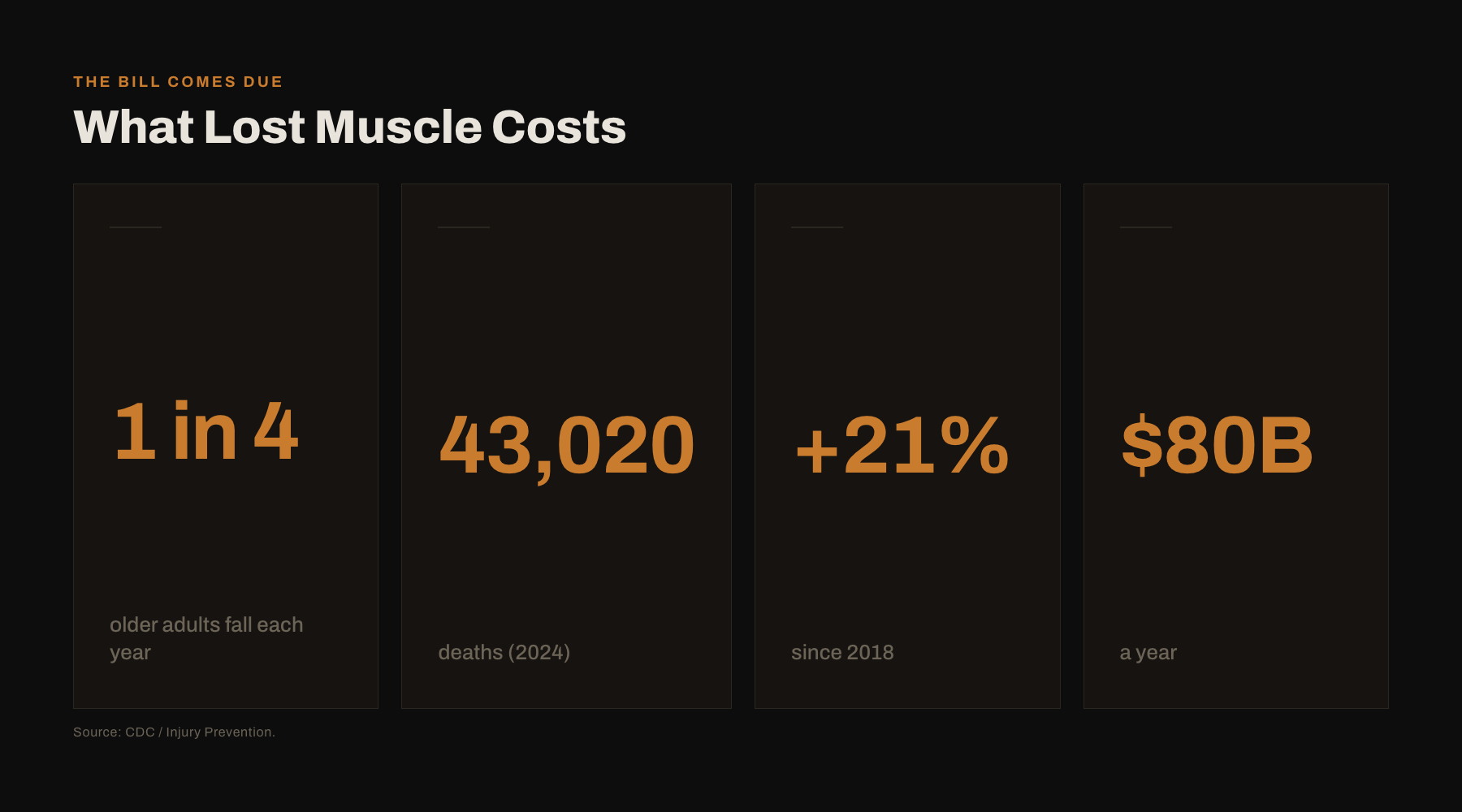
Muscle is not about a mirror. It is the thing standing between a person and the single most expensive, most quietly lethal event in later life: the fall. One in four older adults falls every year, more than fourteen million people. Falls are the leading cause of injury death for Americans over sixty-five, and the rate is climbing, up twenty-one percent since 2018, to more than forty-three thousand deaths in 2024 alone. The healthcare bill for nonfatal falls alone was about eighty billion dollars.
The root of the falls crisis is the muscle crisis, and the muscle crisis is the disease they named and stopped looking for.
If you are forty, none of this is a warning about next year. It is the trajectory, and it began a decade ago. The slope is gentle at first and then it is not, and the cheapest time to bend it is now, while it still costs nothing but attention. This is the same mistake the country made with an earlier plague. A century ago, hookworm was written off as Southern laziness, a character flaw of a whole region, until someone realized it was a treatable infection. Sarcopenia is this generation's version. It looks like getting old. It is, in large part, a treatable condition, and the treatment is not exotic. It is protein and use.
What It Is, And How Much
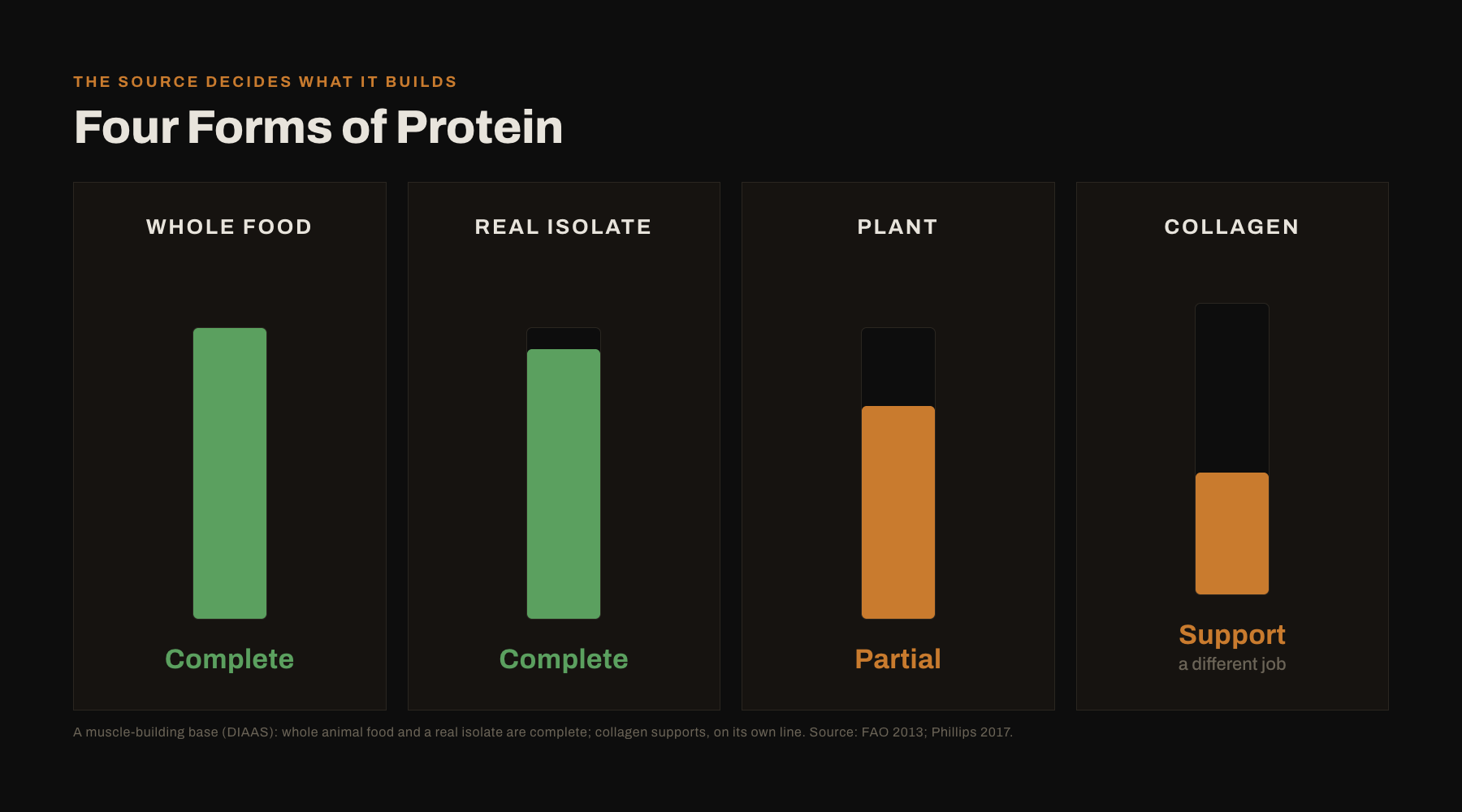
Protein is not one thing. It is a delivery vehicle for nine building blocks your body cannot make on its own, the essential amino acids, and it is called complete only when it carries all nine in usable amounts. Miss one and the whole load is capped by whatever is scarcest, the way a recipe stalls the moment you run out of a single ingredient. That is why the form matters as much as the grams. Tap through the four you will actually meet.
The number that actually protects you
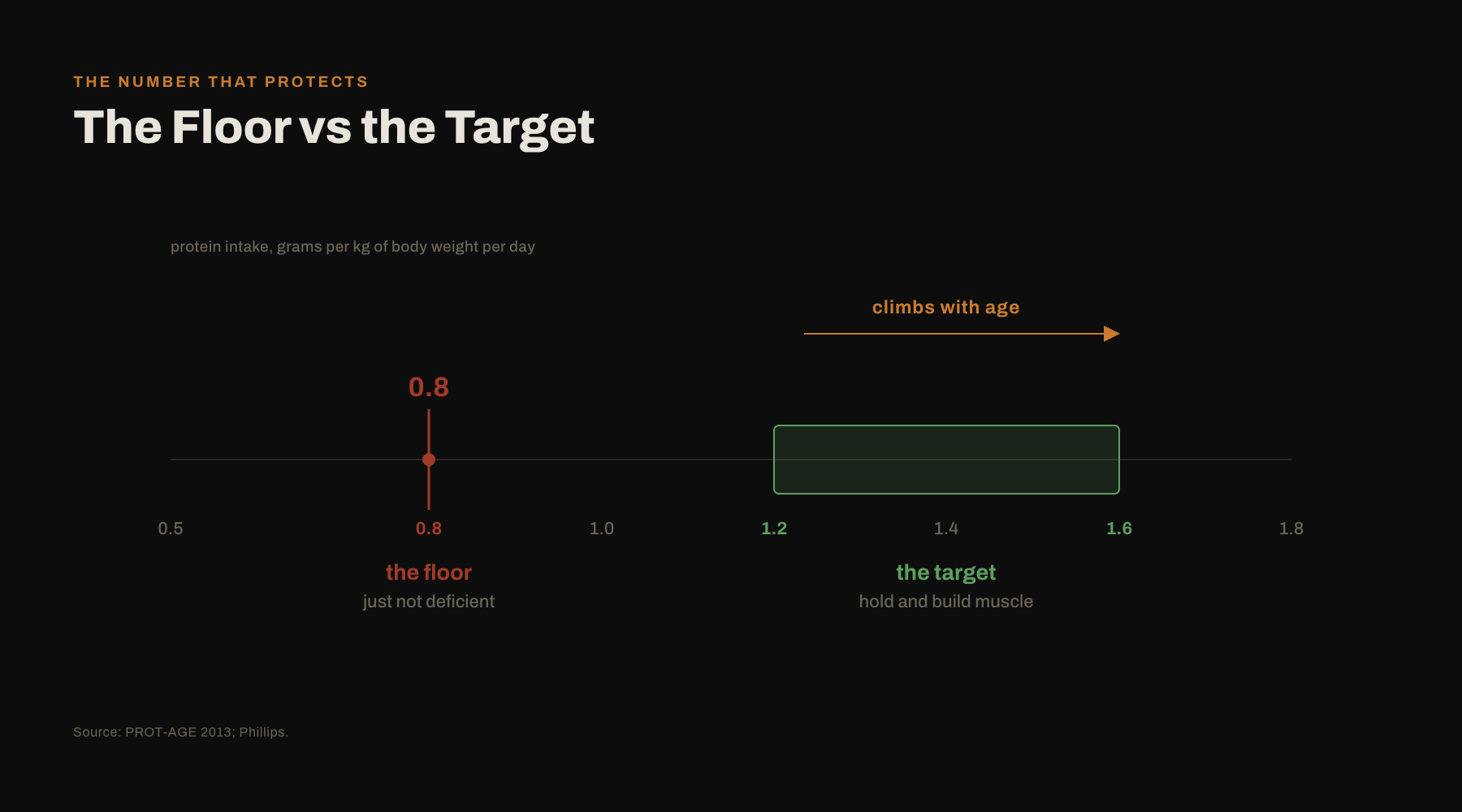
You were given a number, and it was the wrong one for the job. The official protein recommendation, 0.8 grams per kilogram of bodyweight, is a floor. It is the least you can get away with before deficiency, not the amount that holds muscle as you age. The amount that protects and builds is higher, roughly 1.2 to 1.6 grams per kilogram, and it climbs with age rather than falling, because older muscle answers a meal less loudly and needs more protein to hear it. They handed a fifty-year-old the number built to keep a twenty-year-old from getting sick.
Here is the good news buried in that math. Across a whole day, most people are closer than they fear. The average man already eats around 1.3 grams per kilogram if you add up everything he puts away between noon and bedtime. The daily total is not really the problem. The problem is the shape of the day, and it breaks in exactly one place.
The Morning Fills With Everything But It
Ask what a person eats instead of protein in the morning and the answer is almost always the same: refined carbohydrate, in a form built to go down fast and disappear just as quickly. It is not that the morning is empty. It is full. It is just full of everything except the one thing that holds muscle together.
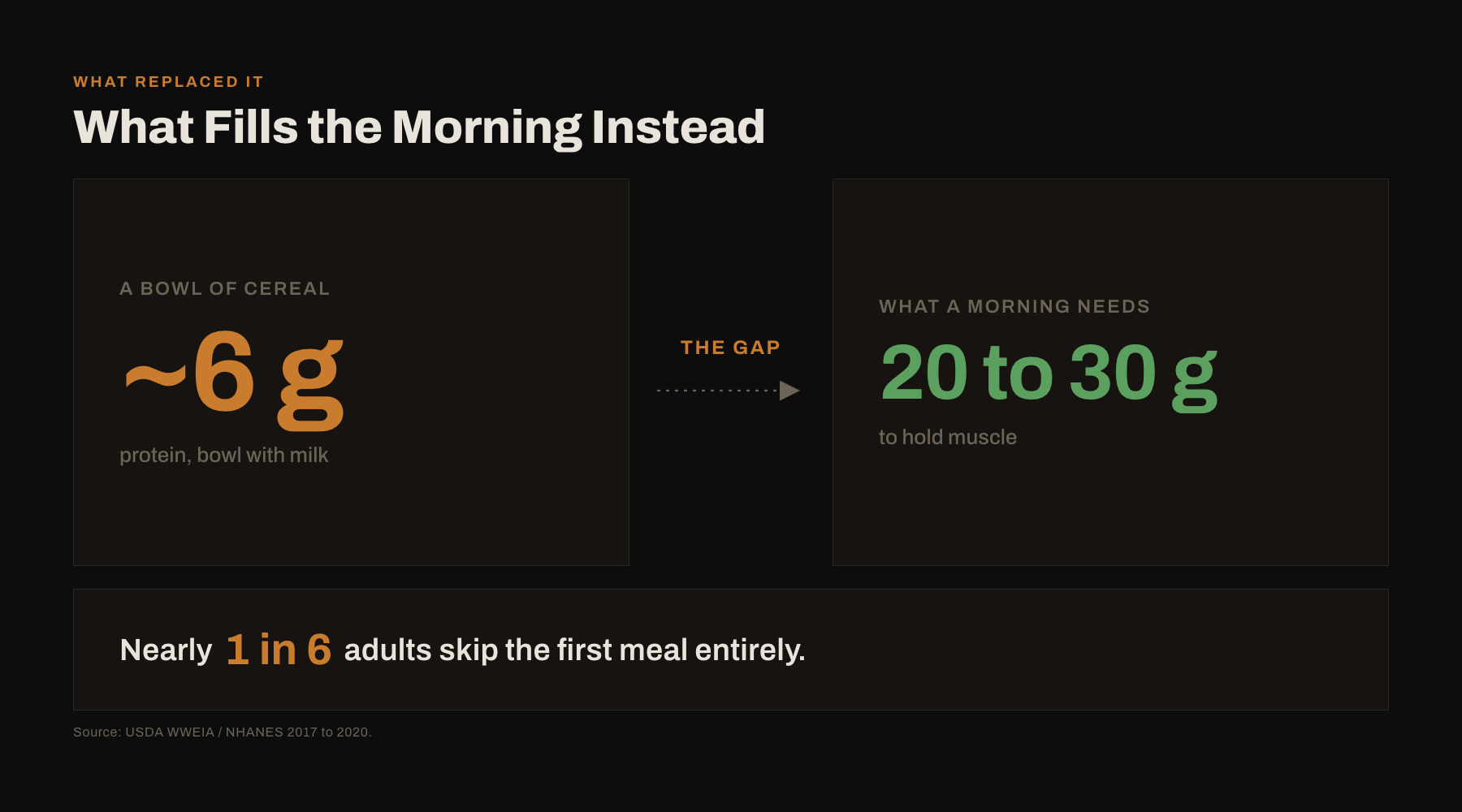
And the morning is where the gap is widest. A bowl of cereal carries about three grams of protein, against the twenty to thirty a real morning needs, and nearly one in six adults skip it outright. Whatever else is on the counter, the protein almost never shows up. Build a normal morning below and watch the one number that matters barely move.
There is one more pressure, quiet and growing. More people than ever are eating less than they used to, by discipline or by prescription, at the exact moment their bodies need protein the most to hold muscle. When the plate shrinks, the margin for a wasted morning disappears. Every gram has to count.
The Day, And The One Gap
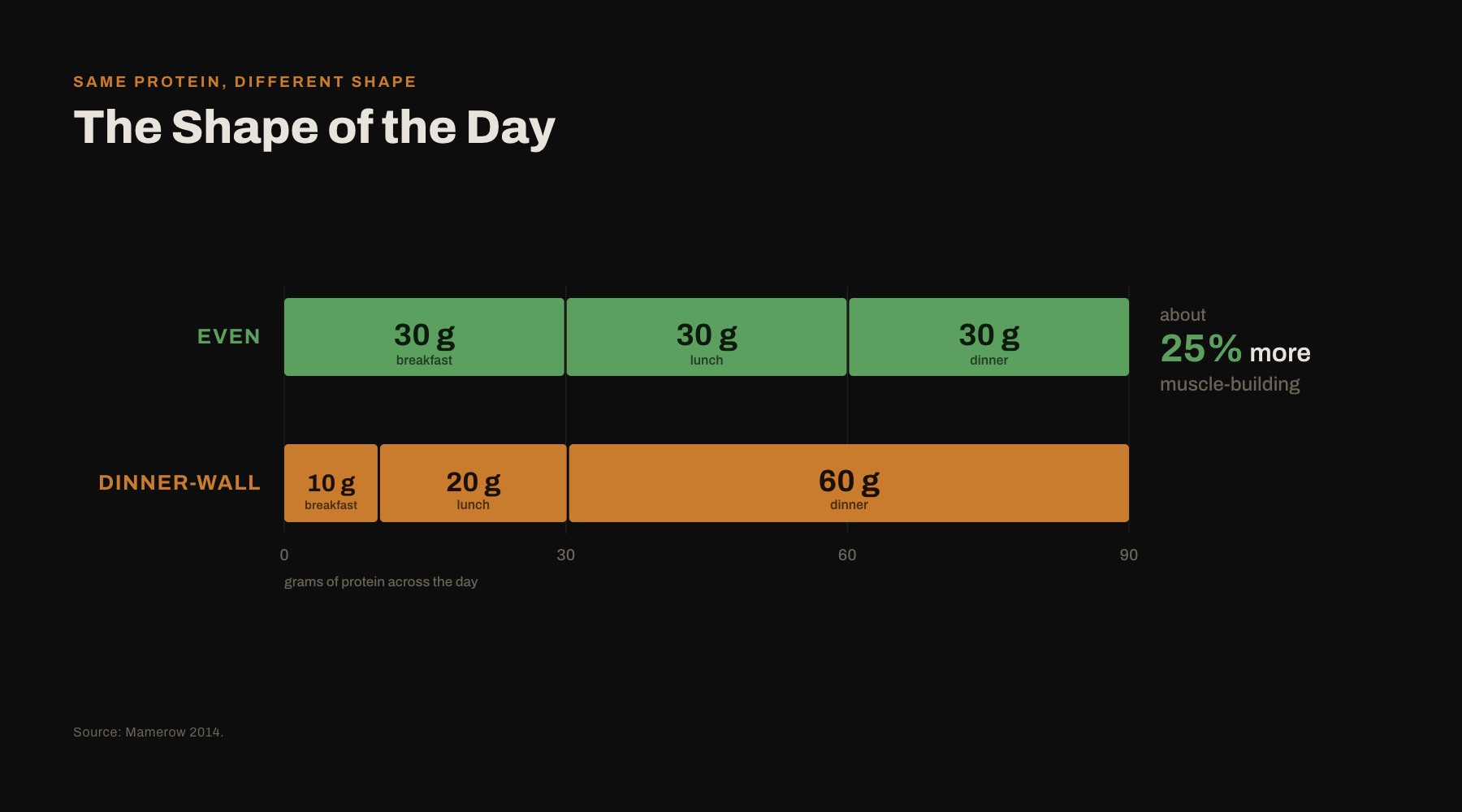
Start with the good news you already earned two pages ago. A full day of protein is not a mountain. Three eggs and a cup of Greek yogurt is thirty grams before you have touched a powder. Real protein at the center of lunch instead of as a topping is another thirty. A normal dinner is thirty more. Ninety grams, out of ordinary food, and most of it you are close to already. What decides whether it works is not the total. It is how you spread it.
A few campaigns ago we talked about a rule some of you will remember: thirty grams of protein within thirty minutes of waking, then thirty minutes of movement. The rule is worth expanding, because the real lesson underneath it is about distribution across the whole day. Your body cannot bank protein. It builds muscle in windows, meal by meal, and each meal has to clear a threshold to open the window at all. Stack it all at dinner and most of that one big dose overshoots what a single window can use. Spread the same amount evenly and you cross the threshold three times instead of once. In a controlled study, that even pattern produced about twenty-five percent more muscle building over a day, on the identical total. Same groceries, better shape. Move your ninety grams around and watch it.
The one meal that never fills
Now look at where the even day wants protein most, and look at your actual mornings. Midday and evening are easy. You are awake, you have time, you are hungry, and real protein is already on the plate. The morning is the opposite on every count. You wake up fasted, having burned through the night, so the need is highest exactly when the tank is emptiest. You are rushed. Your appetite is at its lowest, so a slab of eggs feels like a chore. And whole-food protein is heavy and slow to make first thing. Everyone's protein day has the same hole, and it is the first meal. The typical breakfast lands around eleven grams against a thirty-gram threshold, and no amount of willpower changes the fact that thirty grams of real food at six-forty in the morning is genuinely hard to pull off. Try it yourself.
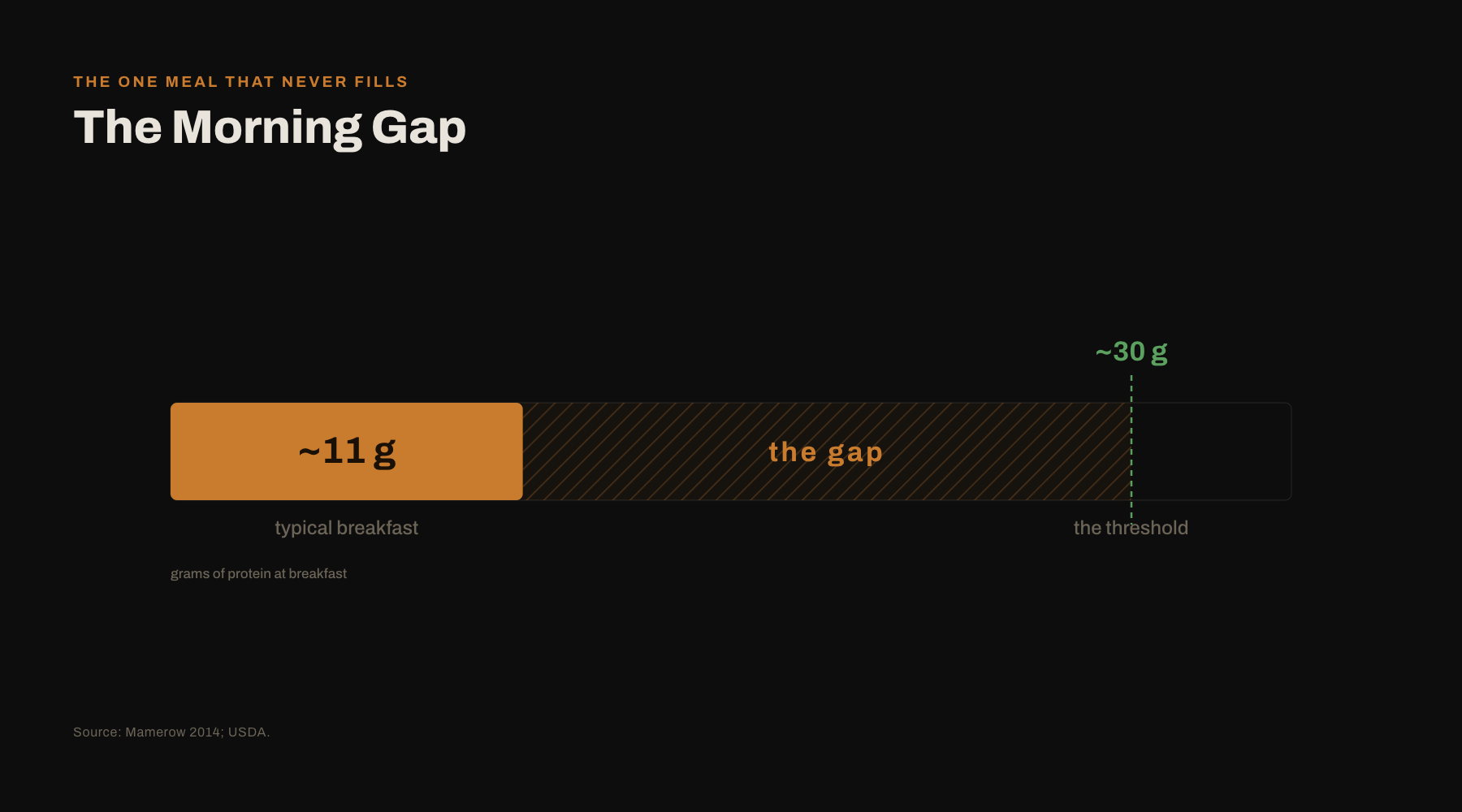
So here is where the book leaves you, honestly. You have your number. You have seen a full day of protein built out of ordinary food, and it was not a mountain. You have watched your own morning come up short, not because you are weak, but because the first meal is built to defeat you: fasted, rushed, appetite low, and real protein slow to make. Lunch and dinner take care of themselves. The morning is the one gap, and it resists every food fix you just tried.

Real protein was never invented. It was eaten. Your great-grandfather opened the day with eggs and meat and had his thirty grams before there was a word for it. What replaced that on your counter is not better protein. It is cheaper protein, and cheaper to sell.
There is a way to put the old thing back in the exact spot the day keeps losing it, built for the one meal that never fills, in the one habit you already keep every morning. It is not one more thing to remember, and it is not another tub to distrust. When it lands, run the same tests this guide taught you on it first: name the source, check for filler, demand real animal protein, and ask whether it survives the way you will actually use it. That is a story for the coming days. For now, you already have everything you need, and you did not have to buy a thing to get it.
To your strength,
Antonio Colmenares
Founder, Black Forest
Be first when it lands.
This guide was the gift, and it stays free whether you ever hear from us again. But the thing built for that one morning gap drops soon, and this list hears first. Leave your number and we will text you the moment it does. Nothing else.
By tapping the button you agree to receive recurring automated marketing texts from Black Forest at this number. Consent is not a condition of purchase. Msg and data rates may apply. Reply STOP to cancel, HELP for help. We never share your number.
The Receipts
- Sarcopenia, ICD-10-CM M62.84, effective October 1, 2016 (CDC). Cao & Morley, "Welcome to the ICD-10 code for sarcopenia," J Cachexia Sarcopenia Muscle 2016; JAMDA 2016.
- Volpi E, et al. Muscle tissue changes with aging. Curr Opin Clin Nutr Metab Care 2004. Roughly 3 to 8% muscle lost per decade after 30, accelerating later.
- Sarcopenia before 60: ~8.76% of US adults 18-59 (about 1 in 11) meet FNIH sarcopenia criteria. Li Z, et al., Medicine (Baltimore) 2025 (NHANES 2011-2018).
- CDC/NCHS, NHANES 2021-2023: 72.4% of US adults are overweight or obese (obesity 40.3%). NCHS Data Brief 508 (2024).
- Metabolic health: only 12.2% of US adults are metabolically healthy. Araujo J, et al., Metab Syndr Relat Disord 2019 (a stricter 2022 JACC estimate: 6.8%).
- Sarcopenic obesity ~28.3% of US adults 60+ (low muscle with excess fat), NHANES-based prevalence.
- CDC Older Adult Falls: ~1 in 4 fall yearly; leading cause of injury death in 65+; fall-death rate up ~21% since 2018 to 43,020 deaths (2024); ~$80B nonfatal-fall spending (Injury Prevention, 2024).
- Doherty TJ. Invited Review: Aging and sarcopenia. J Appl Physiol 2003. Roughly 30 to 50% of muscle is lost between ages 40 and 80.
- Brauer CA, et al. Incidence and mortality of hip fractures in the United States. JAMA 2009. One-year mortality after hip fracture is roughly 20 to 30%, about 1 in 4.
- FAO (2013) DIAAS; Phillips SM (2017) protein quality by source. Collagen is incomplete (low in tryptophan) and complements rather than replaces complete protein: Paul, Leser & Oesser, Nutrients 2019.
- Bauer J, et al. (PROT-AGE), JAMDA 2013. Target ~1.2 to 1.6 g/kg, rising with age (anabolic resistance). USDA WWEIA intake ~96 g/day (men).
- USDA WWEIA / NHANES 2017-2020 (Breakfast Consumption by US Adults, USDA ARS): ~85% eat breakfast on a given day, so ~15% (nearly 1 in 6) skip it; cereal ~3 g/serving.
- Mamerow MM, et al. Protein distribution and 24-h muscle protein synthesis. J Nutr 2014 (~25% more on even distribution; ~11 g typical breakfast vs ~30 g threshold). 30-30-30 framing: Ferriss / Brecka.
- Nothing here contradicts an honest formula. This guide never faults an ingredient for existing, only a protein number for hiding what is behind it. Complete animal protein is the standard it holds up; any second protein, like collagen, belongs on its own line, printed honestly, doing its own job. A real, honestly labeled protein passes every test in these pages.
This guide is educational and is not medical advice. It does not diagnose, treat, cure, or prevent any disease, including sarcopenia. Protein targets and quality scores are population averages and vary by person and product. Talk to your physician before changing your diet or exercise, especially if you have a health condition or take medication. Individual results vary.
Hold The Line
To your strength,
Antonio Colmenares
Founder, Black Forest